Benefits of Group Transport for School & Activities
Why children travelling together in a supervised school van or bus is safer, cheaper and better for them than individual arrangements, and what makes group transport work well.
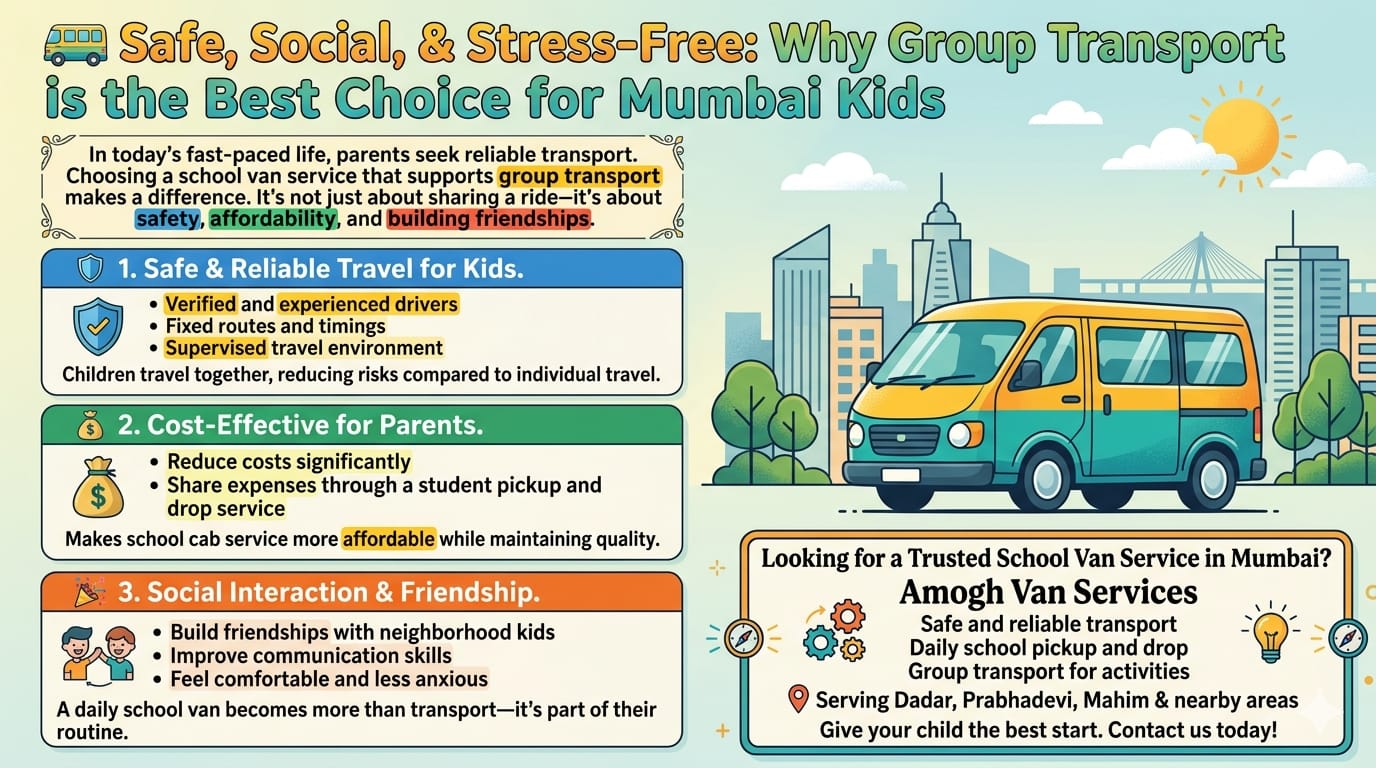
In a city like Mumbai, getting a child to school, tuition or a weekend activity is a daily logistics exercise for parents. Some families arrange a separate auto or cab, some drop the child themselves, and many choose group transport: a school van or bus that carries several children from the same area on a fixed route. Group transport is sometimes seen as simply the cheaper option. In reality its biggest advantages are about safety, routine and the child's own experience. This article explains those benefits, and also what makes group transport work well, because not every shared ride is equally good.
1. Supervision that individual rides cannot offer
When a child travels alone in an auto or app cab, there is one adult in the vehicle: a driver who is a stranger, whose attention is on the road, and who changes from day to day. A properly run group vehicle is different:
- The same driver and attendant every day, known to every parent on the route.
- An attendant whose job is the children, not the road: boarding, seating, behaviour and handover.
- A fixed list of children, so a missing child is noticed immediately.
- Clear handover rules at the stop, instead of a child being dropped at a gate and left.
This supervision is the single biggest reason many parents prefer group transport, especially for younger children.
2. A predictable, fixed routine
Group routes run on fixed timings and fixed stops. Children know exactly when to be ready, parents know roughly when the child will be home, and the whole household can plan around it. Predictability also helps children who find transitions difficult. The same faces, the same seat and the same route every day become a comfortable part of their routine.
3. Lower cost for each family
Sharing a vehicle spreads the cost of fuel, the driver's salary, maintenance, insurance and permits across many families. A dedicated cab for one child twice a day is far more expensive than a seat in a shared van or bus over a month. That said, cost should never be the only factor. An extremely cheap fee can be a sign of an overloaded vehicle or no attendant, which removes the very safety advantage that makes group transport worthwhile.
4. Less traffic around schools and homes
One school van carrying ten or twelve children replaces up to ten or twelve separate car, scooter or auto trips at the school gate. Multiply that across a school, and the difference in congestion, and in the risk to children crossing near the gate, is significant. Fewer vehicles also mean less fuel burned and less pollution in the neighbourhood during peak hours.
5. Friendships and social confidence
Children who travel together every day often become close friends. Older children help younger ones with their bags, siblings and neighbours look out for each other, and shy children gradually find their feet in a small, familiar group. For many adults, some of their fondest school memories are of the ride itself. A well-supervised van can offer the same.
6. Easier independence for older children
As children grow, parents naturally want to give them more independence, but city roads make that difficult. Group transport is a comfortable middle step: children travel without a parent, learn to manage their own bags and timings, and handle small responsibilities, while still being supervised by trusted adults.
7. Beyond school: tuition, activities and trips
Group transport is useful for more than the school day. Classes, coaching, sports practice and school excursions all involve moving groups of children at fixed times. Organising a shared vehicle for children from the same building or society attending the same activity brings the same benefits of supervision, predictability and lower cost.
What makes group transport work well
The benefits above depend on the operator doing the basics properly. Before choosing a group service, check that:
- Every child has a proper seat, and the vehicle is never overloaded.
- An attendant travels on the route, especially for young children.
- The vehicle has valid registration, permit, fitness and passenger insurance.
- The driver is experienced and verified, and you have met them.
- There are clear rules for delays, absences and who may receive your child.
- Parents on the route can communicate with the operator easily.
Is group transport right for your child?
For most families living within a reasonable distance of school, a well-run group service offers the best balance of safety, cost and convenience. It may be less suitable when a child needs one-to-one support that a shared vehicle cannot provide, or when the only available route involves a very long ride. In those cases a private arrangement may be better, and a good operator will say so honestly.
Amogh Van/Bus Services has run group school routes in Prabhadevi, Dadar West and nearby areas since 2010. If you would like to know whether a route covers your building and school, please call us or visit our contact page.