The Mumbai Monsoon School Commute: A Practical Guide for Parents
Four months of the school year in Mumbai happen in heavy rain. Here is how the commute actually changes during monsoon, what a well-run transport operator does differently, and what you can do at your end to make the journey less miserable.
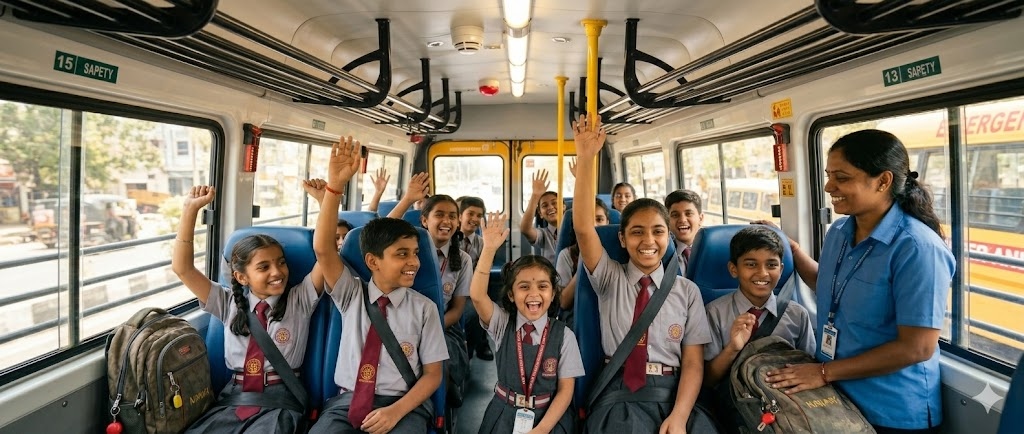
The Mumbai school year and the Mumbai monsoon overlap almost exactly. School reopens in June, the rain arrives around the same time, and for the next four months every school commute in the city happens on wet roads, through standing water, in traffic that moves at a fraction of its usual speed.
Most parents plan for the monsoon at home — raincoats, spare uniforms, waterproof bags — and then treat the commute as something that simply becomes unreliable for a few months. It does become slower. But a lot of what makes it difficult is manageable, on both sides.
What actually changes
Journeys take considerably longer
A route that takes 35 minutes in February can take an hour or more on a heavy rain day. This is not primarily the rain itself. It is waterlogging closing lanes, traffic signals failing, other vehicles breaking down in standing water, and everybody who normally takes a train deciding to drive instead.
The practical implication is that pickup times often move earlier during monsoon. If your operator does not do this, ask why. Leaving at the usual time and hoping is not a plan.
Visibility drops sharply
Heavy rain reduces what a driver can see to a fraction of normal, and it reduces what other drivers can see of your child crossing the road. This is why boarding discipline matters more in monsoon than at any other time of year.
Braking distances increase
Wet roads mean longer stopping distances. A well-maintained vehicle with good tyres handles this. A vehicle with worn tyres does not, and monsoon is when that difference stops being theoretical.
Standing water becomes a genuine hazard
The risk with waterlogged roads is not only the water. It is that the water hides open drains, missing manhole covers and potholes. A driver who does not know a road well can put a wheel into a hole that is invisible under 30 centimetres of water.
What a well-run operator does differently in monsoon
If you want to know whether your transport operator takes the monsoon seriously, these are the things to look for:
- Tyres checked before the season, not during it. Tread depth is what keeps a vehicle from aquaplaning. This is a pre-monsoon job.
- Wipers and defoggers actually working. Worn wiper blades smear rather than clear, and a fogged windscreen in heavy traffic is dangerous.
- Alternative routes identified in advance. Every experienced Mumbai driver knows which stretches flood first. That knowledge should be used to plan diversions before the road closes, not after.
- Earlier departures on heavy rain days.
- A working communication channel. When a vehicle is stuck, parents need to know within minutes.
- Floors kept dry. Wet steps and wet floors are a slipping hazard for a child carrying a heavy bag.
- A clear decision on when not to run. On days of extreme rainfall, the right answer is sometimes that the vehicle does not go out.
What helps at your end
Have your child ready earlier
Three minutes of waiting at one pickup point compounds across a route. In monsoon, when the whole journey is already slower, it is the difference between arriving before assembly and arriving after it.
Waterproof the bag, not just the child
A raincoat keeps a child dry. It does nothing for the notebooks. A waterproof bag cover, or a large plastic bag inside the school bag around books, prevents the daily misery of soaked homework.
Send a spare set of clothes in June
Not for every day — just a spare uniform kept at school for the inevitable day when your child arrives soaked. Most schools accommodate this readily.
Footwear matters more than people think
Leather school shoes in monsoon are miserable and slippery. Most Mumbai schools permit alternative footwear during the rains. It is worth asking, because a child slipping while boarding a vehicle is one of the more common monsoon injuries.
Keep your phone reachable
Monsoon is the season when your operator most needs to reach you at short notice. If your number has changed, or if you routinely keep your phone on silent during work, that is worth addressing before June rather than during a flood.
Have a backup plan for extreme days
On the handful of days each year when Mumbai effectively stops, transport will not run. Decide in advance what happens: who collects your child, whether they stay at school, whether they stay with a relative nearby. Deciding this in June is much easier than deciding it at 2pm during a red alert.
Health during the season
Monsoon brings a predictable set of illnesses, and a shared vehicle is a place where they spread.
- A child who arrives wet and stays in wet clothes through the morning is more likely to fall ill. This is the practical argument for the spare uniform.
- Dengue and malaria rise during and after the rains. Mosquito repellent applied before the morning commute is reasonable, particularly if the pickup point has standing water nearby.
- Water-borne illness increases sharply. A child should carry their own water bottle and not share it.
- If your child has asthma, monsoon humidity and mould can aggravate it. Tell your transport operator. It belongs in the medical information they hold, and the attendant should know.
When the vehicle is stuck
It happens. Roads close, traffic stops, and a journey that should take 40 minutes takes two hours. What should happen:
- The driver stays with the vehicle and the children. The vehicle is the safest place for them.
- Parents are informed, with an honest estimate rather than a reassuring one.
- Children are kept calm and occupied. An attendant matters enormously here.
- If the situation deteriorates, the operator makes a decision — returning to school, or moving to a safe nearby location — and tells parents what it is.
What should not happen is silence. If you cannot reach anyone at your transport operator while your child is on a stuck vehicle, that is a serious failure, and it is worth weighing heavily when you decide whether to continue with them next year.
The realistic summary
The Mumbai monsoon commute will be slower and wetter than the rest of the year, and no operator can change that. What they can control is whether the vehicle is prepared, whether the driver knows the alternative routes, and whether you are told what is happening. What you can control is preparation at your end and a plan for the worst days.
Between the two, the monsoon commute becomes an inconvenience rather than a source of anxiety — which, over four months of the school year, is worth the small amount of planning it takes in May.
If you have questions about how monsoon affects a specific route in Prabhadevi, Dadar or the surrounding areas, call us on 9870525637.