Teaching School Bus Safety: What to Expect at Each Age
A five-year-old and a thirteen-year-old need completely different safety conversations. What to teach at each stage, why the danger zone around the vehicle matters most for the youngest, and why teenagers are riskier passengers than parents expect.
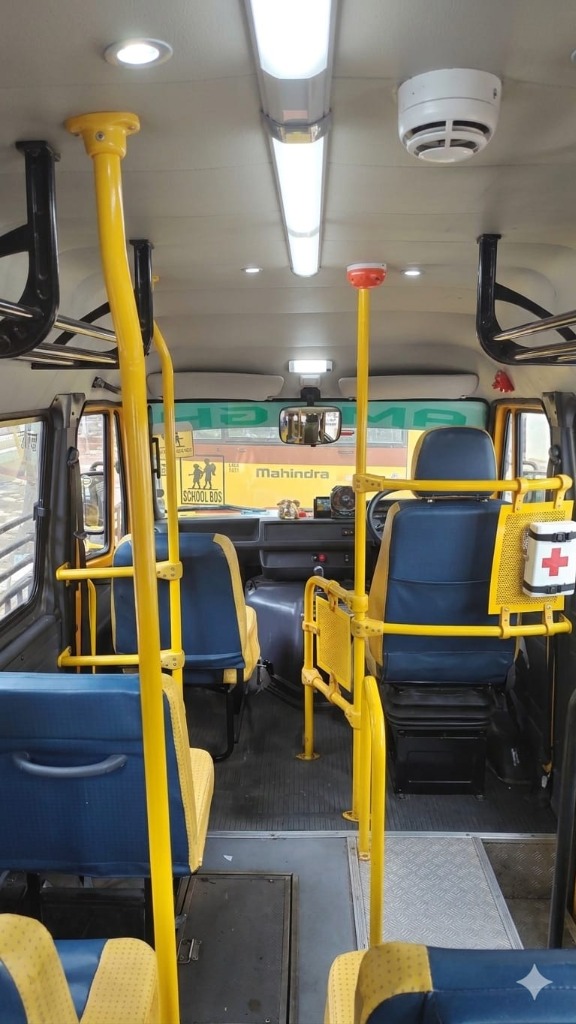
Most school transport safety advice is written as a single list of rules for "children". In practice a child in senior KG and a child in Class 8 face different risks, understand different things, and need different conversations.
What follows is organised by stage, based on what we see on our routes.
The one thing that applies to every age: the danger zone
Before anything age-specific, there is a concept every child should understand, and most do not.
The danger zone is the area immediately around a stopped vehicle — roughly three metres on every side — where a child is difficult or impossible for the driver to see. Large vehicles have substantial blind spots directly in front, directly behind, and along the sides near the wheels.
A significant proportion of school transport injuries worldwide happen not in collisions on the road but in this zone, around a stationary vehicle, often involving the vehicle the child was travelling on.
The rules that follow from it are simple enough for a small child:
- Stay far enough back that you can see the driver's face. If you cannot see them, they cannot see you.
- Never walk behind the vehicle.
- Take ten steps ahead before crossing in front, so the driver can see you.
- If you drop something near the vehicle, leave it and tell an adult. Never bend down to pick it up.
That last rule is the one worth repeating most often. Children instinctively reach for a dropped water bottle, and it takes them out of sight at exactly the wrong moment.
Ages 3 to 5: nursery and kindergarten
At this stage children cannot reliably judge traffic, cannot be relied on to follow a rule under stress, and should not be managing any part of the journey alone.
What to teach:
- Hold an adult's hand until you are on the vehicle.
- Sit down and stay sitting.
- The attendant is the person who helps you.
- Tell the attendant if you feel sick or need the toilet.
What a parent should handle: an adult must be present at both ends, every single day. The vehicle must have an attendant — at this age this is not optional. Put your phone number in your child's bag, and make sure the operator has a second contact who is actually reachable.
Realistic expectation: your child will not remember the rules reliably. The safety here comes from the adults, not from the child.
Ages 6 to 8: early primary
Children can now follow rules they understand, but still misjudge speed and distance badly. They are also confident enough to move around when an adult is not watching, which is a new risk.
What to teach:
- The danger zone, properly. This is the right age to teach it.
- Wait on the footpath, not the kerb, until the vehicle has fully stopped.
- Hold the handrail when boarding.
- Stay seated while moving, and keep the aisle clear.
- Keep hands, head and belongings inside the window.
- Your bag goes under the seat, not in the aisle.
Worth adding: teach your child their own address and your phone number by heart at this age. It is useful well beyond the commute.
Realistic expectation: they will follow the rules when someone is watching. Reinforcement matters more than a single explanation.
Ages 9 to 12: upper primary
Children now understand the rules and can usually be trusted to follow them. The risk shifts from ignorance to distraction, and to social pressure from other children.
What to teach:
- Everything above, now framed as a reason rather than an instruction. Children this age follow rules they understand better than rules they are told.
- Do not distract the driver. Noise in the vehicle is a genuine safety issue, not merely bad manners.
- If another child is behaving dangerously, tell the attendant. Make clear this is not telling tales.
- Put the phone away while boarding and alighting. Walking into a road looking at a screen is the classic injury at this age.
- Where the emergency exit is and how it opens.
The conversation worth having: that it is always acceptable to tell you about something uncomfortable on the vehicle, and that they will not be in trouble for it. Children this age begin filtering what they tell their parents, and you want the channel open before you need it.
Ages 13 and above: secondary
Parents tend to stop thinking about transport safety once a child is thirteen. This is a mistake. Teenagers understand every rule perfectly and are markedly more likely to break them.
Adolescents are more likely to stand while the vehicle is moving, lean out of windows, change seats in traffic, remove a seatbelt, encourage a driver to go faster, and treat safety rules as something for younger children. The risk is not comprehension. It is social.
What to emphasise:
- Seatbelt on, every journey, no exceptions.
- Stay seated while the vehicle is moving, regardless of who else is standing.
- Headphone volume low enough to hear the attendant, and off entirely when boarding or alighting.
- You set the example for the younger children on the vehicle, who are watching you closely.
- Report a driver who is on the phone, appears unwell, or is driving dangerously. Teenagers are often the only passengers who will notice and can articulate it.
The framing that works: responsibility rather than restriction. A thirteen-year-old told to sit down responds poorly. The same child asked to keep an eye on the Class 1 students at the front usually responds well.
Things worth teaching every child, regardless of age
- How to get help. Who to tell, and that telling is always the right move.
- That they can say no to an adult. If anybody other than their usual driver or attendant asks them to get into a vehicle, the answer is no, and they should tell you immediately.
- Never leave with anyone you have not authorised, however plausible the explanation.
- What to do if the vehicle does not come. Go back inside, or back into school, and call you. Not wait alone on the road, and not start walking.
How to teach it so it sticks
A single lecture at the start of the year does not work. What does:
- Practise physically. Walk to the stop and stand where they should stand. Ten steps is a concept; ten actual steps is a memory.
- Keep it short and repeat it. Two minutes occasionally beats twenty minutes once.
- Give the reason. "The driver cannot see you there" works better than "do not stand there".
- Do not use fear. A frightened child is a child who panics rather than thinks.
- Model it. If you cross behind the vehicle while telling your child not to, the demonstration wins.
What you should expect from the operator
The child's side of this only goes so far. The operator should be doing their part: an attendant supervising boarding and alighting, drivers who wait until children are clear before moving, stops chosen so that children are not crossing busy roads unnecessarily, and a register confirming who is on board.
If you are not sure what happens at your child's stop, ask. Or watch one morning — it is the most direct way to find out.
We are happy to talk through the arrangements on any of our routes. Call 9870525637.